Bỏ qua để đến Nội dung

Decree 324 on financial policies applicable to the IFC in Vietnam

The Government has recently promulgated Decrees on the establishment and operation of International Financial Center (IFC) in Vietnam

AI isn’t just evolving risk management — it’s helping reengineering it. Artificial intelligence (AI), including generative AI (Gen AI) and agentic AI, is driving a seismic shift in how organizations anticipate, assess, and act on risk. The old playbook of manual processes, backward-looking assessments, and fragmented frameworks is being replaced by intelligent systems that learn, adapt, and act in real time. According to the KPMG Future of Risk Survey, 400 executives rank AI and Gen AI as by far the most popular type of technologies for managing additional risk responsibilities in the next three to five years.

AI in Risk Management

Leverage AI in your risk management ecosystem

Explore today’s AI maturity landscape, discover standout use cases, and chart a fast path to an AI-enabled future of risk.

↓ Download the article


The five stages of AI maturity in risk management
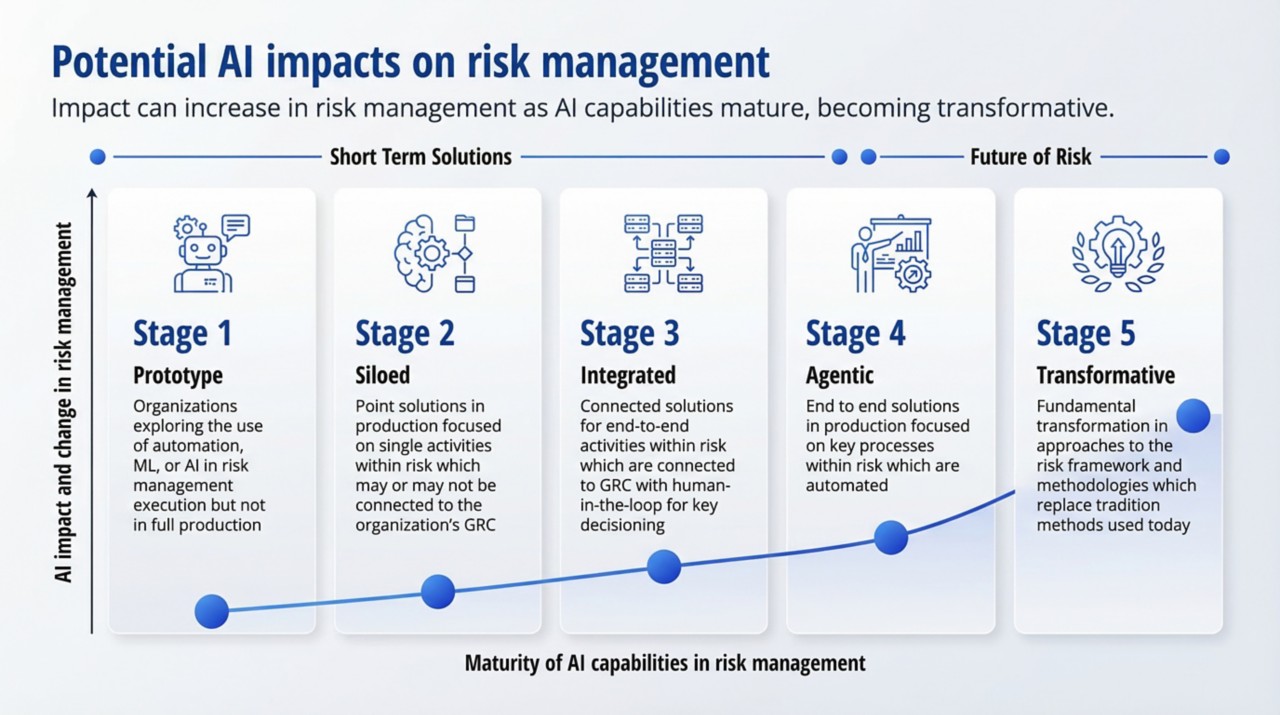
Findings from our research

Risk identification

AI can generate process flows, detect emerging risks, and recommend mappings to risk taxonomies, processes, and controls. This helps organizations identify risks more accurately and earlier.


Risk monitoring

AI enables real-time or continuous monitoring of risk indicators, producing aggregated reporting and moving from point-in-time reporting to more dynamic, real-time capabilities.

Risk assessment

AI can recommend risk ratings, generate and monitor key risk indicators, and calculate residual risk. By making risk assessment more probabilistic, AI can enhance the precision and consistency of risk ratings.


Risk review and reporting

AI can help improve the efficiency and quality of risk reporting by automating the generation of reports, thematic analysis, and standardized risk and control report outputs.

Risk mitigation

AI tools support decision making around risk response strategies and automate or optimize mitigation actions. For instance, they can identify issues and root causes, review and design control inventories, and monitor alerts more efficiently and precisely.


Testing and validation

AI can automate control testing activities, validate control effectiveness, and detect anomalies across large data sets. By continuously learning from historical patterns and outcomes, AI enhances the accuracy, efficiency, and coverage of testing activities — helping reduce manual effort and enabling faster identification of control weaknesses.


Nine steps towards operationalizing AI in your risk management strategy

Pinpoint the pressure points icon

Pinpoint the pressure
points

Build a scalable architecture icon

Build a scalable
architecture

Reskill for the AI era icon

Reskill for the AI era

Get your data in shape icon

Get your data in shape

Modernize and stabilize your tech icon

Modernize and stabilize
your tech

Invest in trust-building icon

Invest in trust-building

Pilot with purpose icon

Pilot with purpose

Bring regulators and third line constituents along icon

Bring regulators and third line constituents along

Govern the new risks icon

Govern the new risks

AI is helping revolutionize risk management

Accelerate growth and build lasting resilience with KPMG Velocity. Expect to change smarter and move faster - eliminating inefficiencies and building trust and confidence, at every step.

KPMG Velocity

Change smarter, move faster with KPMG Velocity.

Start your transformation journey


Pham Do Nhat Vinh
Thành viên Điều hành
Consulting, Head of Financial Services
KPMG Việt Nam

Tran Huu Tuan
Director
Financial Services
KPMG Việt Nam


Chia sẻ bài này